
Land-Locked to Land-Linked: The Trillion-Kip Startup Opportunities Aboard the Pan-Asia Railway
For decades, Laos faced a massive economic bottleneck: its status as a mountainous, land-locked nation. Moving freight meant relying on slow, unpaved roads and costly trucking routes.
Xinhua
All of that has fundamentally changed. The China-Laos Railway has shattered these physical barriers. By early 2026, cumulative cross-border cargo trade topped 80 million tons. Daily cross-border train traffic has scaled up from just 2 trains a day at launch to an astonishing 23 trains per day.
Global Times+ 1
With Thailand’s segment of the high-speed rail pushing forward toward its 2030 completion, Laos has transformed into the ultimate land-linked logistics hub of mainland Southeast Asia. For agile startups and foreign investors, this new “green corridor” drastically slashes transit times—cutting shipping costs by 30% to 50%.
Mekong Institute+ 1
The infrastructure is ready. The real question is: Where are the most lucrative startup opportunities?
Two sectors stand out as high-demand, high-yield goldmines: Cold Chain Food Supply Networks and Healthcare Logistics & Manufacturing.
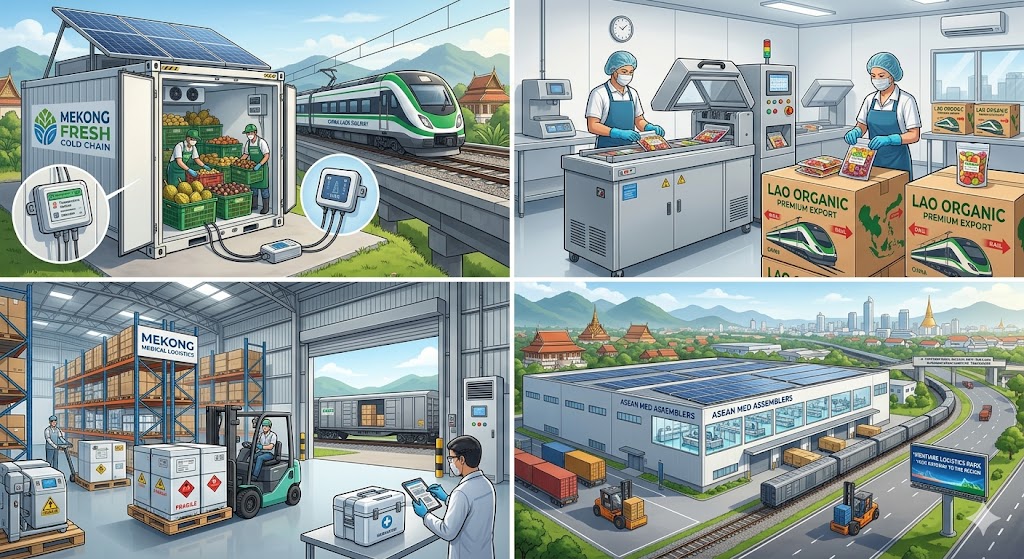
1. The Food Supply Chain: Cold Chain Logistics & Export Processing
Laos exports more than 80% of its agricultural goods to China. Concurrently, billions of dollars of high-value Thai fruits (like durian) cross through the Vientiane South/Thanaleng Dry Port terminal bound for Chinese consumers.
Xinhua+ 1
The Core Problem
Despite the high-speed trains, Southeast Asian fresh food still faces “the last mile” and “the first mile” decay. There is a massive deficit in temperature-controlled warehousing, localized sorting, and modern cold-chain handling facilities inside Laos. Fresh produce spoils quickly if the cold chain breaks at the rail terminals.
The Startup Opportunities
- Micro-Cold Storage & Shared Hubs: Establishing modular, solar-powered cold storage facilities adjacent to secondary railway stations (e.g., Luang Prabang, Vang Vieng, Muang Xay) that smallholder farmers can rent via an app.
- Smart Cold-Chain Tracking SaaS: Developing IoT-sensor platforms that monitor temperature and humidity inside cross-border containers in real-time, instantly alerting shipping companies of potential spoilage before the train crosses the border.
- Value-Add AgTech Processing: Setting up boutique processing plants in the Vientiane Logistics Park (VLP). Instead of exporting raw, heavy fruits, startups can process, freeze-dry, vacuum-seal, and brand premium Lao organics directly for low-tariff rail entry into China.
[ Problem: 30%+ Fresh Food Spoilage via Traditional Freight ]
                       ⬇
[ Rail Breakthrough: 40-Hour Cold-Chain Express Routes ]
                       ⬇
[ Startup Value: Smart Processing & Modular Storage Tech ]
Strategic Business Breakdown
| Metric | Business Opportunity |
|---|---|
| Market Demand | Chinese consumer demand for fresh tropical fruit and Lao organic produce. |
| Value Proposition | Guarantees zero-spoilage and speeds up time-to-market by converting raw agricultural transit into ready-to-sell packaged exports. |
2. Healthcare & Medical Supply Chains: Distributing to the Mekong Subregion
The modern railway has cut shipping times for complex manufacturing components from major industrial hubs like Chongqing down to a mere five days (compared to 20 to 30 days via sea and road). This creates an unprecedented opportunity for medical assembly and pharmaceutical distribution.
Asia News Network
The Core Problem
Mainland Southeast Asia relies heavily on importing completed medical devices and pharmaceuticals from distant global suppliers, which creates massive supply chain vulnerabilities. Simultaneously, landlocked regions struggle to get immediate access to critical life-saving equipment, specialized medical wear, and laboratory components.
The Startup Opportunities
- Export-Oriented Medical Device Assembly: Utilizing the specialized Export Processing Zones (EPZ) in Vientiane to assemble medical diagnostic kits, PPE, surgical tools, or disposable items. Raw plastics and electronics can be imported via rail from China, assembled in Laos utilizing competitive local labor, and exported zero-tariff to Thailand, Vietnam, and Malaysia. HKTDC Research
- Cross-Border Pharma Distribution Hubs: Building compliant, temperature-regulated pharma-grade warehouses at the Thanaleng Dry Port. Startups can act as regional super-distributors, breaking bulk medical shipments arriving from China and dispatching them rapidly into Thailand via rail and road feeder networks.
- B2B Medical Marketplace Platforms: A regional digital procurement platform linking Lao and Thai hospitals/clinics with medical manufacturers along the rail line, streamlining custom clearances and volume-purchasing.
Strategic Business Breakdown
| Metric | Business Opportunity |
|---|---|
| Market Demand | Hospitals and clinics across the Greater Mekong Subregion requiring fast, reliable access to affordable medical equipment. |
| Value Proposition | Drastically reduces medical hardware procurement cycles from months to days by holding stock directly at the regional rail epicenter. |
How to Position Your Startup for Success
Laos is aggressively rolling out its Trade and Transport Facilitation Action Plan (2025–2030), aimed at cutting import-export licensing times by 40% and slashing customs clearance times at border gates by at least half.
Nhan Dan Online
To win in this ecosystem, successful startups shouldn’t try to build the railways or the massive trains. Instead, build the digital and physical layer that plugs into them. Focus on smart warehousing, localized value-adding processing, and digital logistics software. The tracks are laid—it’s time to build the businesses that run on them.
- Tags: #LaosStartup #BeltAndRoad #SupplyChain #SoutheastAsiaBusiness #AgTech #MedTech #Logistics